
English PDF · 12 pages · 473 KB
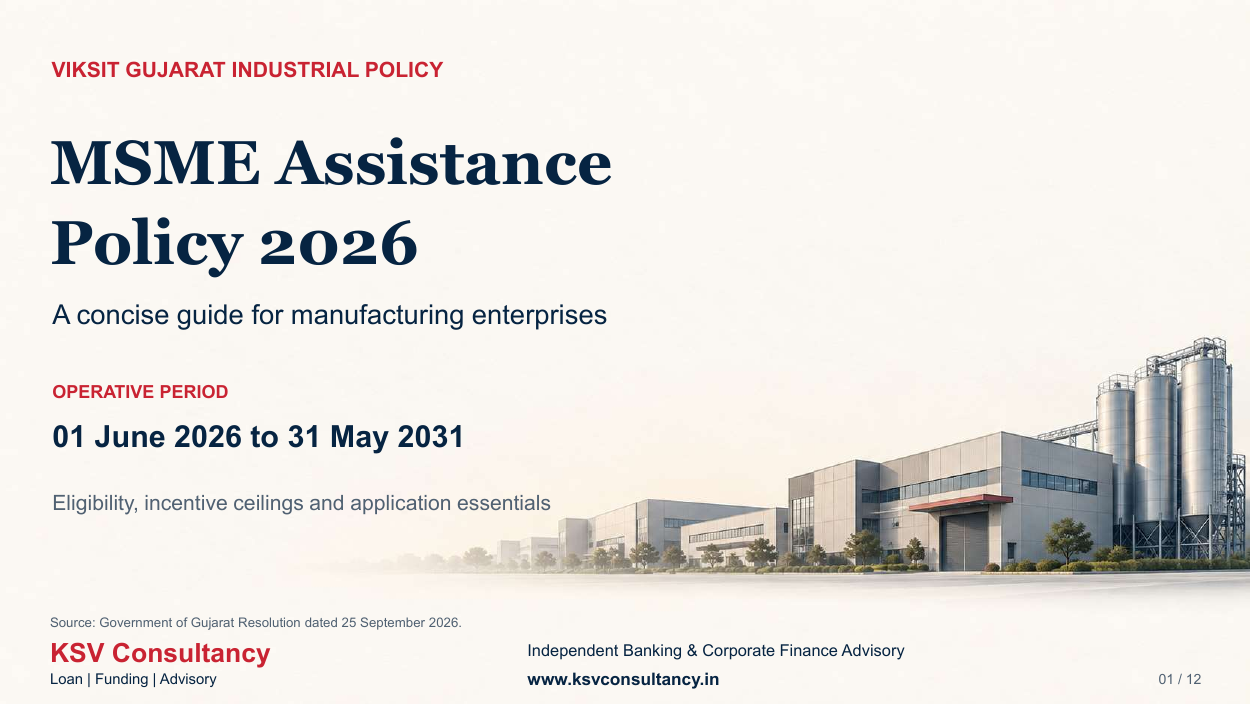
Gujarat MSME Policy 2026
A concise, 12-page KSV synopsis covering eligibility, incentives, ceilings and application essentials for manufacturing enterprises.
About this guideKnowledge Centre
Read KSV’s practical notes on credit preparation, working capital, funding choices and client situations. The purpose is simple: help business owners ask better questions before approaching lenders.
Showing all resources
Practical summaries you can read, save and share. No message or sign-up required.
English PDF · 12 pages · 473 KB
A concise, 12-page KSV synopsis covering eligibility, incentives, ceilings and application essentials for manufacturing enterprises.
About this guideConcise KSV explainers to help businesses understand common funding structures, prepare stronger proposals and ask better questions before approaching a lender.
English video · 9 s
The lender may consider guarantee cover for the eligible unsecured portion. Approval is not automatic.
Working Capital · 18 September 2026
GST-reported sales can support limit assessment, while banks also review margins, operating cycles and account conduct.
MSME Finance · 17 September 2026
Understand how eligible MSE credit may be considered under a guarantee-backed structure, subject to lender assessment.
Working Capital · 16 September 2026
Begin with updated financials, stock and receivable data, projections and compliance information before the review date.
Credit Assessment · 15 September 2026
Test whether projected cash flow can service principal and interest commitments with an appropriate operating cushion.
Business Finance · 13 September 2026
Quantify the additional inventory and cash-flow requirement before arranging finance for increased input costs.
Order Finance · 12 September 2026
Review execution costs, margins, collection timing and temporary funding needs before committing to a large order.
Business Finance · 11 September 2026
Consider whether a suitable business loan can support higher input costs, inventory levels or longer receivable cycles.
Credit Assessment · 10 September 2026
DSCR compares cash available for debt service with principal and interest commitments under the proposed structure.
Business Finance · 9 September 2026
Lenders assess business vintage, turnover, profitability, cash flow, banking conduct and existing obligations.
Banking Discipline · 8 September 2026
Cheque returns, overdue payments, irregular drawings and unexplained transactions can weaken a credit assessment.
Working Capital · 7 September 2026
Match seasonal or order-led funding needs with a clear amount, utilisation period and source of repayment.
Project Finance · 6 September 2026
A clearly evidenced promoter contribution demonstrates commitment and supports assessment of the proposed project structure.
Credit Preparation · 5 September 2026
Maintain disciplined transactions and prepare explanations for unusual entries before submitting statements to a lender.
Debt Advisory · 3 September 2026
Consolidation may simplify repayments, but the revised structure should improve cash flow and the overall debt burden.
Banking · 1 September 2026
Review pricing, repayment, security, conditions and obligations before accepting a facility.
Credit Preparation · 31 August 2026
Organise the requirement, financial information and repayment logic before approaching lenders.
Property-Backed Funding · 30 August 2026
Evaluate the interest rate, tenure, repayment effect and overall structure of long-term borrowing.
Financial Planning · 29 August 2026
Translate expected sales, collections and payments into a clearer view of funding requirements.
Banking · 28 August 2026
Consistent information, timely communication and disciplined account conduct support lender confidence.
Non-Fund Based Facilities · 27 August 2026
Forecast tender requirements and assess suitable limits, terms and documentation before deadlines.
Financial Discipline · 25 August 2026
Practical habits that strengthen banking conduct, lender confidence and borrowing readiness.
Business Finance · 24 August 2026
Understand operating-cycle gaps and how a suitable facility can support everyday business needs.
Retail Finance · 22 August 2026
Consider purpose, affordability, valuation, tenure and overall borrowing cost when using property-backed finance.
Short, practical pieces for promoters and management teams who are evaluating loans, working capital, banking arrangements or financial decisions.
Loan Documentation
A practical review of facility structure, pricing, repayment, security, covenants and pre-disbursement conditions.
Read articleWorking Capital
Understand the business cycle, financial information and account conduct that shape a lender's assessment.
Read articleBank Guarantees
Define the guarantee, check tender wording and assess limits, timelines and documentation early.
Read articleBanking
A practical framework for presenting the business, requirement, risks and repayment logic.
Read articleWorking Capital
How to identify whether the issue lies in margins, inventory, receivables or debt structure.
Read articleDecision Making
Why the purpose, timing and operating impact of capital should be understood before raising it.
Read articleThese illustrative case notes show how businesses can approach common funding decisions. No client names or confidential transaction details are disclosed.
Illustrative Case Note
How a growing business can review receivables, stock, limits and cash-flow timing before asking for additional banking support.
Read case note →Illustrative Case Note
How LAP, mortgage-backed borrowing, balance transfer or top-up requirements can be evaluated before finalising the structure.
Read case note →Illustrative Case Note
How bid bonds, guarantees and non-fund based requirements should be prepared early so the business is ready before tender deadlines.
Read case note →Have a question behind the article?Speak with KSV if your business is evaluating a loan, banking proposal, working capital issue, LAP, guarantee requirement or financial decision.
Begin a Conversation